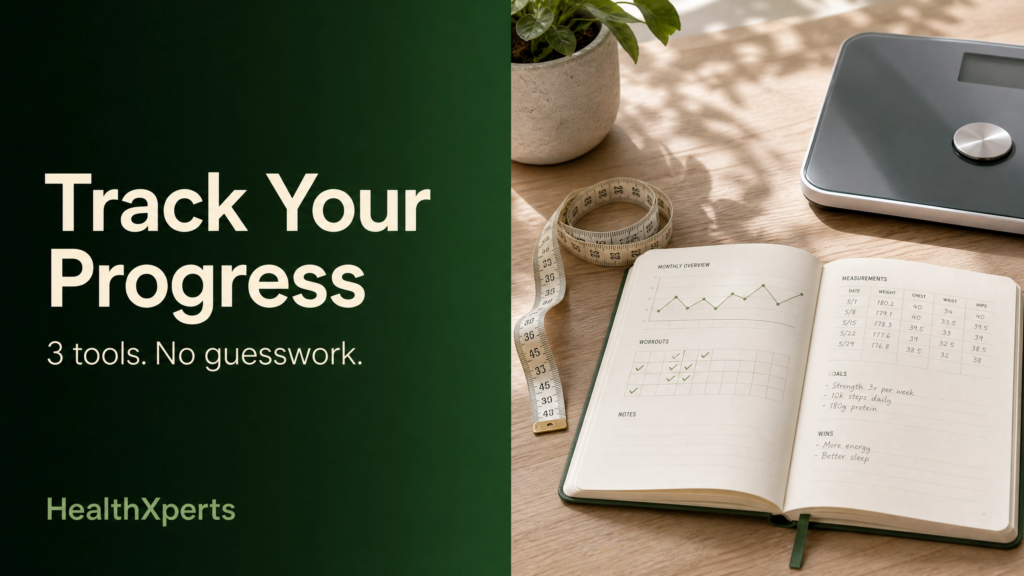
Not sure which tracking methods work best for you? Start with our guide to tracking your fitness progress at home. It covers five simple methods before you spend anything.
A lot of people train consistently for six weeks and then stop. Not because the training isn’t working. Because they can’t tell that it is.
You look in the mirror every day. You see the same face, the same body. Changes that happen gradually are invisible to someone who’s looking daily. It’s like watching the minute hand on a clock.
Numbers don’t have that problem. A tape measure doesn’t care that you had a bad morning. A journal doesn’t forget what you lifted last week. These tools turn a feeling into a fact, and facts keep you going when motivation doesn’t.
As an Amazon Associate I earn from qualifying purchases. This post contains affiliate links. If you purchase through these links I may earn a small commission at no extra cost to you.
Why the Mirror and the Scale Aren’t Enough
Here’s what catches most beginners off guard: when you start strength training and eating well, your body can lose fat and build muscle at the same time. Your weight on the scale might barely move. Sometimes it goes up.
That’s not failure. That’s body recomposition. Muscle is denser than fat, so you get leaner without the number dropping. But if the scale is your only feedback, it feels like nothing’s happening. That’s when people quit.
The fix is measuring more than one thing. Your waist is shrinking while your weight holds steady? That’s progress you can prove. Your goblet squat went from 6kg to 10kg in four weeks? That’s progress you can see in your journal. One number alone can mislead you. Three numbers together tell the real story.
The 3 Tools You Need
LYTOWN Body Tape Measure
Retractable | Soft & flexible | Marked in cm and inches
A body tape measure catches changes that the bathroom scale misses completely. Waist, hips, chest, arms, thighs. These are the measurements that actually tell you whether your body is changing shape.
Soft and flexible so it wraps around your body without digging in. Retractable so it doesn’t get tangled in a drawer. Marked in both centimetres and inches.
Take measurements once a week, same day, same time, same spots. Write the numbers in your journal. After four weeks, the trend line tells you more than any mirror ever will.
Check Price on Amazon →Etekcity Digital Bathroom Scale
Large display | Step-on technology | Tempered glass platform
Yes, the scale alone isn’t enough. But that doesn’t mean it’s useless. Weight is one data point. Paired with tape measurements, it tells you whether the number is fat loss, muscle gain, or water fluctuation.
Step on, get a reading. No buttons, no apps, no Bluetooth setup. Just a number on a screen. That simplicity matters because you’ll use it. A complicated smart scale that needs syncing every morning is a smart scale that stays in the cupboard.
Weigh yourself once a week, same day, first thing in the morning, after using the toilet, before eating. That gives you the most consistent reading. Write it down alongside your tape measurements.
Check Price on Amazon →Nextnoid Fitness Journal
Structured workout logging | Body measurement tracker | Up to 8 months of training
A fitness journal does something no app can match: it makes you write down what you did, with a pen, on paper. That small act of logging forces you to notice patterns. Are your weights going up? Are you skipping the same exercises? Did you train three times last week or just twice?
The Nextnoid journal has structured pages for logging exercises, sets, reps, and weights, plus dedicated sections for body measurements. One book covers up to 8 months of training, so you’re not replacing it every few weeks.
The biggest benefit is progressive overload. If your journal says you did 8 reps of goblet squats at 8kg last Tuesday, you know this Tuesday’s target is 9 reps or 10kg. Without a record, you’re guessing. And guessing is why progress stalls.
Check Price on Amazon →Want a structured plan to track against?
The free 28-Day Home Fitness Blueprint gives you a day-by-day workout schedule with progression built in. Log each session in your journal and watch the numbers climb.
Download the Free Blueprint →The Weekly Check-In: 5 Minutes, Once a Week
Pick a day. Sunday morning works well because it’s before the week starts and you’re in a routine.
Step 1: Weigh yourself. First thing in the morning. Write the number in your journal.
Step 2: Take your measurements. Waist at the navel. Hips at the widest point. Chest at nipple line. Both arms, flexed, at the widest point. Both thighs at the midpoint. Write them all down.
Step 3: Review your training log. How many sessions did you complete this week? Did your weights or reps go up on any exercises? Note which ones.
That’s it. Five minutes. After four weeks, you have a month of data. That data answers the question “is this working?” honestly, without relying on how you feel or how the mirror looks on a Tuesday morning. For a full breakdown of tracking methods, see our guide on how to track fitness progress at home.
What the Numbers Actually Tell You
Here’s how to read the three numbers together:
Weight steady, waist shrinking: Body recomposition. You’re losing fat and building muscle. This is the result most beginners get and the one the scale alone would make you miss.
Weight dropping, waist shrinking: Fat loss. Straightforward and encouraging.
Weight up, waist same: Likely water retention or muscle gain. Check the trend over two or three weeks before drawing conclusions.
All numbers flat for four weeks: Something needs changing. Either the training intensity, the nutrition, or both. This is where your journal helps: look at whether your weights have been going up. If they haven’t, that’s your answer. For a deeper look at what body composition changes actually look like, read our article on what a DEXA scan reveals after 12 weeks of training.
Common Questions
Why not just use a phone app?
You can. But writing by hand takes more focus than tapping a screen, and that focus is part of the point. You process what you did differently when you write it out. The journal also means your phone isn’t in your hand mid-workout, which removes a distraction.
How often should I weigh myself?
Once a week is enough. Daily weigh-ins show water fluctuations that mean nothing and cause stress. Weekly, same conditions, gives you a clean trend line.
Which measurements matter most?
Waist and hips are the two most useful for tracking fat loss. Arms and thighs show muscle growth. If you only measure two things, make it waist and weight.
Do I need a smart scale with body fat percentage?
Not really. Consumer-grade body fat readings from bathroom scales are unreliable. They shift based on hydration, time of day, and what you ate. A tape measure around your waist gives you a more honest picture of fat loss than any number a smart scale estimates.
How This Fits Into the Bigger Picture
Training gives you the stimulus. Nutrition gives you the fuel. Tracking gives you the feedback. Without feedback, you’re hoping it works. With feedback, you know.
If you haven’t set up your training equipment yet, start with our complete home gym starter kit. If your nutrition isn’t dialled in, see our meal prep for beginners guide. This article covers the third piece.
Ready to start tracking?
Download the free 28-Day Home Fitness Blueprint. It includes a progress tracker, weekly check-in template, and a day-by-day schedule that pairs your workouts with your meals.
Download the Free Blueprint →HealthXperts provides general fitness information for healthy adults. This is not medical advice. If you have a health condition, injury, or are recovering from surgery, speak to your GP or physiotherapist before starting any exercise programme.