One of the most frustrating experiences in fitness is putting in the work and not knowing if it’s paying off.
The scales aren’t moving. You can’t tell if you look different. You’re not sure if you’re getting stronger. And without clear feedback, it’s easy to lose motivation or convince yourself that nothing is working.
The problem usually isn’t the training. It’s the tracking. Most people either don’t track at all, or they rely on the one measure (bodyweight) that gives the most misleading picture of progress.
Here’s how to track your fitness progress at home accurately, simply, and in a way that actually keeps you motivated.
Why Tracking Matters
Tracking does two important things. First, it tells you whether what you’re doing is working, so you can adjust if it isn’t. Second, it shows you how far you’ve come, which is one of the most powerful motivators available.
Progress in fitness is often slow enough that it’s invisible day-to-day. You won’t notice your strength increasing from one session to the next. But looking back at where you were 8 weeks ago tells a completely different story.
Without a record, that story gets lost. You forget how hard the first workout felt. You forget that you couldn’t do a full set without stopping. Tracking preserves that evidence, and on the hard days, it’s exactly what you need to keep going.
Method 1: Track Your Workouts
This is the most important thing you can track, and the one most beginners skip. Writing down what you did in each session. Exercises, weights, sets, and reps. Creates a record of your strength progress over time.
It also makes progressive overload possible. Without knowing what you lifted last week, you can’t know whether you’re progressing this week.
Keep it simple. For each session, note:
- The date
- Each exercise
- The weight used
- Sets and reps completed
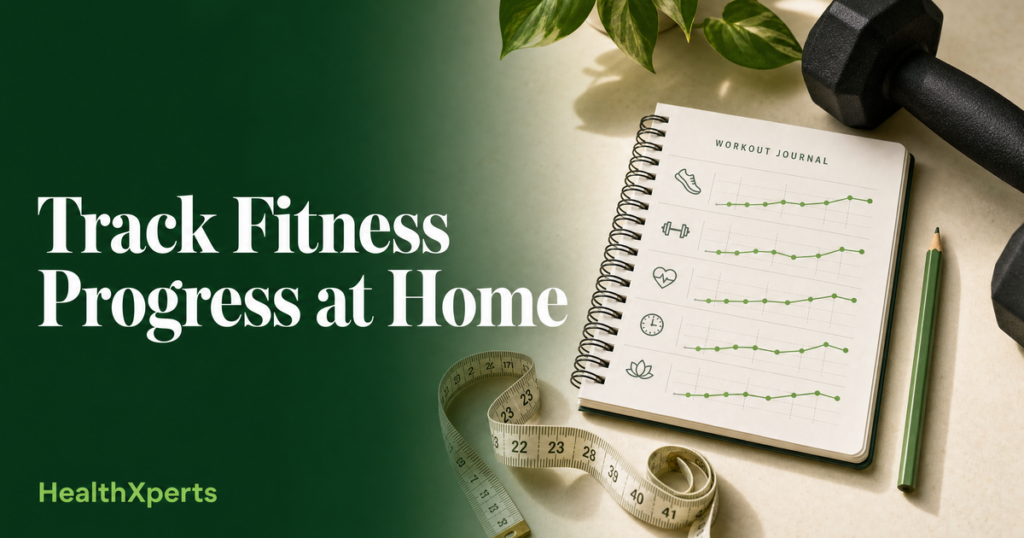
A notebook works perfectly. So does the notes app on your phone. Some free apps like Strong or FitNotes make this even easier with built-in logging.
After 4 weeks, look back at week one. The difference in what you can lift will likely surprise you, and that concrete evidence of progress is one of the most motivating things in fitness.
Method 2: Take Progress Photos
Progress photos are one of the most reliable ways to see body composition changes, and one of the most commonly avoided, because nobody enjoys taking photos of themselves at the start.
The reason they work is that physical changes happen so gradually that your brain adapts to them. You see yourself every day, so you stop noticing the difference. A photo from 8 weeks ago shows you what your brain has already stopped registering.
For consistent, comparable photos:
- Take them every 2–4 weeks, same day of the week
- Same time of day (morning, before eating, is best)
- Same lighting and location
- Same poses. Front, side, and back
- Same clothing (or as little as you’re comfortable with)
You don’t need to share them with anyone. They’re for you. Keep them in a private folder and compare them side by side every month.
Method 3: Take Body Measurements
A tape measure gives you objective data that a photo can’t, and it’s often more motivating than the scales. Waist measurements decreasing while your shoulders and arms stay the same (or increase) tells a clear story of fat loss and muscle gain, even when your weight hasn’t changed much.
The key measurements to track:
- Waist. At the narrowest point, or at the navel
- Hips. At the widest point
- Chest. Across the widest part
- Upper arm. At the widest point, relaxed
- Thigh. At the widest point, mid-thigh
Measure every 2–4 weeks, at the same time of day. Morning measurements before eating are the most consistent. Log the numbers and look for trends over 4–8 week periods, not week to week, where natural fluctuations can mislead you.
Method 4: Track Your Bodyweight, but Do It Right
Bodyweight is a useful data point, but it’s easily misread. Your weight fluctuates by 1–3kg day to day based on water retention, food volume, hormones, and other factors that have nothing to do with fat loss or muscle gain.
Weighing yourself once and reacting emotionally to the number is one of the most common ways people lose confidence in a programme that’s actually working.
A better approach:
- Weigh yourself at the same time each day (morning, after using the bathroom, before eating)
- Log the number without reacting to it
- At the end of each week, calculate your average for the week
- Compare weekly averages, not individual daily readings
Weekly averages smooth out the natural fluctuations and give you a much clearer picture of whether your weight is trending in the right direction. A downward trend in weekly averages over 4 weeks tells you the programme is working, even if individual days showed increases.
🎯 Want a structured plan to track from day one?
The free 28-Day Home Workout Blueprint gives you a complete 4-week programme with a built-in structure for tracking your progress every step of the way.
Get the Free Blueprint →Method 5: Track Performance Milestones
Some of the most meaningful progress markers in fitness aren’t physical. They’re performance-based. These milestones are often more motivating than aesthetic changes because they’re concrete achievements you can point to.
Examples of home workout performance milestones to track:
- The first time you complete all 4 rounds of a circuit without stopping
- Moving from 6kg to 8kg dumbbells on a key exercise
- Going from 8 reps to 12 reps at the same weight
- Completing your workout in less time than when you started
- An exercise that used to leave you breathless feeling manageable
Write these down when they happen. On the days when progress feels slow, reading back through your performance milestones is a powerful reminder of how far you’ve actually come.
How to Put It All Together
You don’t need to use all five methods simultaneously. Start with the two that feel most manageable and build from there. Our tracking tools buying guide narrows it down to three affordable items and a five-minute weekly check-in.
A simple starting system:
- Every session: Log your workout (exercise, weight, sets, reps)
- Every week: Calculate your average bodyweight
- Every 4 weeks: Take progress photos and body measurements
That’s it. Five minutes of logging per session, five minutes of reviewing per month. In return, you get a clear, objective picture of whether your training is working, and the motivation that comes from seeing real evidence of progress.
Frequently Asked Questions
How long before I see results from home workouts?
Strength improvements typically start within 2–3 weeks. Visible body composition changes usually take 4–8 weeks to become noticeable in photos, and 8–12 weeks before others start noticing. The timeline varies based on consistency, nutrition, and starting point, which is exactly why tracking from the beginning matters.
What if my weight goes up even though I’m training?
This is common and usually not a problem. When you start resistance training, muscles retain water as part of the repair process. Your weight may increase slightly in the first 2–4 weeks even as you’re losing fat. This is why tracking body measurements and photos alongside weight gives a much more accurate picture than the scales alone.
Do I need a fitness tracker or smartwatch?
No. A notebook, a tape measure, a set of scales, and your phone camera are all you need. Fitness trackers can be useful for monitoring sleep and heart rate, but they’re not necessary for tracking the progress metrics that matter most for home strength training.
How often should I reassess my programme?
Every 4 weeks is a sensible review point. Look at your workout log. Are you consistently progressing? Look at your measurements and photos. Is your body composition moving in the right direction? If yes, keep going. If not, identify the one thing most likely to be holding you back (usually nutrition or insufficient progressive overload) and address that first.
Final Thoughts
Tracking your fitness progress at home doesn’t need to be complicated. A workout log, a tape measure, and a camera on your phone are enough to build a clear, honest picture of what’s working.
Start tracking from day one, not because you need to be perfect, but because future you will be grateful for the evidence of how far you’ve come. If you’re still setting up, our home gym starter kit covers the equipment side, and our meal prep for beginners guide handles the nutrition.
Ready to start? Download the free 28-Day Home Workout Blueprint and begin your first month with a clear structure, a tracking framework, and everything you need to see real results.
This post contains affiliate links. If you purchase through these links I may earn a small commission at no extra cost to you.
📏 Recommended Tape Measure. LYTOWN Body Measuring Tape
⭐⭐⭐⭐⭐ 4.5 stars | 6,200+ reviews | Amazon’s Choice | £10.40 | 2-pack, retractable, 60 inch
Check Price on Amazon →🔢 Recommended Scales. Etekcity Bluetooth BMI Scale
⭐⭐⭐⭐⭐ 4.7 stars | 346,000+ reviews | Overall Pick | £14.67 | Measures BMI, body fat & more
Check Price on Amazon →📓 Recommended Workout Journal. Nextnoid Fitness Planner
⭐⭐⭐⭐⭐ 4.8 stars | 2,500+ reviews | £10.40 | Hardcover, A5, tracks gym & home workouts
Check Price on Amazon →