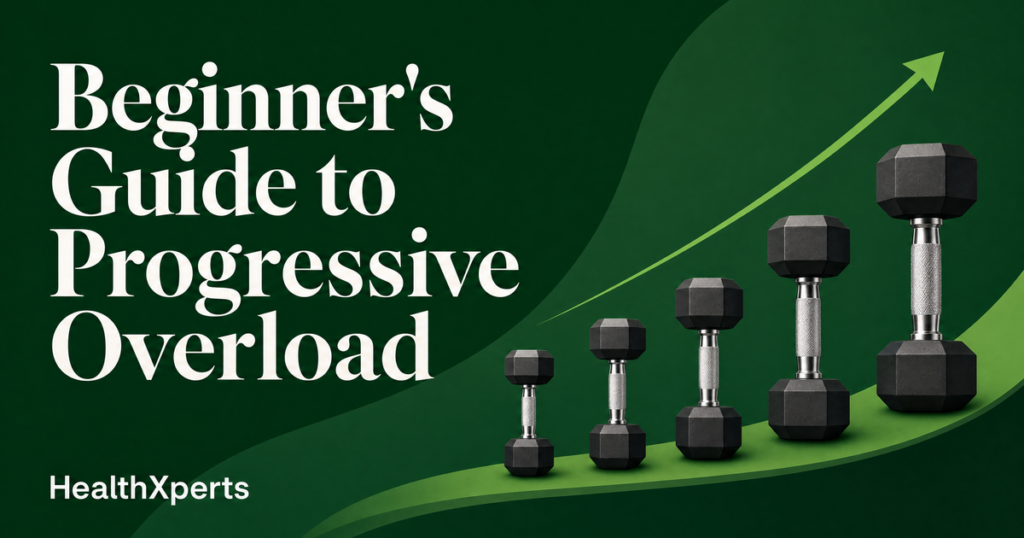
If you’ve been doing the same home workout for weeks and stopped seeing results, progressive overload is the missing piece.
It’s the principle that separates people who keep getting stronger from people who plateau after a few weeks. And it’s surprisingly simple once you understand how it works.
The good news: you don’t need a gym full of equipment to apply it. A single pair of dumbbells and the right approach is all it takes.
Here’s everything you need to know as a beginner.
What Is Progressive Overload?
Progressive overload is the practice of gradually increasing the demand placed on your muscles over time. When your muscles are challenged beyond what they’re used to, they adapt. They repair, rebuild, and grow slightly stronger. Over weeks and months, those adaptations add up to real, visible results.
The key word is gradually. You’re not trying to dramatically increase difficulty every session. Small, consistent increases applied week after week are what drive long-term progress.
Without progressive overload, your body has no reason to change. Once it adapts to a workout, doing the same thing again and again simply maintains where you are. It doesn’t move you forward.
Why Most Beginners Stop Seeing Results
When you first start working out, almost anything works. Your body is new to the stimulus, so even basic movements produce noticeable improvements in strength, muscle tone, and fitness.
But after 4–6 weeks, your body has adapted. The same workout that once challenged you now feels manageable. If you keep doing the same exercises, same weights, and same reps, your results slow down and eventually stop.
This is why so many beginners feel like they’ve “hit a wall.” It’s not their genetics or their age. It’s simply that the programme stopped progressing.
How to Apply Progressive Overload With Dumbbells
There are several ways to make a workout progressively harder over time. You don’t need heavier weights every week. You have more tools than that.
1. Increase the Weight
The most straightforward method. When your current weight feels manageable across all sets, move up by 1–2kg.
Example: You’re doing 3 sets of 10 dumbbell rows at 8kg and the last set feels easy. Next session, try 10kg.
2. Increase the Reps
Keep the weight the same but do more reps per set. This is especially useful when you don’t have the next weight increment available.
Example: You’re doing 3 sets of 8 goblet squats at 10kg. Next session, aim for 3 sets of 10 at the same weight. Once you can do 12 comfortably, increase the weight.
3. Increase the Sets
Add an extra set to your exercises. Going from 3 sets to 4 sets increases your total training volume without changing anything else.
Example: You’ve been doing 3 sets of lunges. Add a fourth set and maintain the same weight and reps.
4. Reduce Rest Time
Shortening the rest periods between sets makes the same workout harder by reducing recovery time. Your heart rate stays elevated and your muscles have less time to recover between efforts.
Example: You’ve been resting 90 seconds between sets. Drop to 75 seconds, then 60 seconds over the following weeks.
5. Slow the Tempo
Slowing down the lowering phase of an exercise (the eccentric phase) significantly increases time under tension. The amount of time your muscles are working during a set. This is one of the most underused methods for home trainers.
Example: Instead of lowering into a squat in 1 second, take 3–4 seconds to lower. Keep the weight the same. You’ll find it significantly harder.
6. Progress to Harder Exercise Variations
Move from easier to harder versions of the same movement pattern. This is progressive overload through exercise selection rather than load or volume.
- Goblet squat → front squat → Bulgarian split squat
- Reverse lunge → walking lunge → deficit lunge
- Bent-over row → single-arm row → Pendlay row
🎯 Want a structured 28-day plan?
The free 28-Day Home Workout Blueprint is built around progressive overload. Each week is slightly harder than the last, so you keep moving forward.
Get the Free Blueprint →A Simple Progressive Overload Plan for Beginners
Here’s a straightforward 4-week framework you can apply to any dumbbell workout. The goal is one small increase per week. Nothing dramatic, just consistent forward movement.
- Week 1: Learn the movements. Focus on form. Use a weight that feels challenging but controlled for 3 sets of 8 reps.
- Week 2: Same weight, increase to 3 sets of 10 reps.
- Week 3: Same weight, increase to 3 sets of 12 reps.
- Week 4: Increase the weight by 1–2kg. Drop back to 3 sets of 8 reps and repeat the cycle.
This is called a double progression model. You progress reps before weight. It’s one of the most reliable methods for beginners and works well with limited equipment.
How to Track Your Progress
Progressive overload only works if you know what you did last session. Without tracking, it’s easy to think you’re progressing when you’re actually doing the same thing week after week.
You don’t need a complicated system. A simple notepad or the notes app on your phone works perfectly. For each exercise, record:
- The weight used
- The number of sets
- The number of reps per set
Before each session, look at what you did last time. Then aim to do at least one small thing better. One more rep, slightly more weight, or one less second of rest. That’s progressive overload in practice.
Common Mistakes to Avoid
- Trying to progress too fast. Jumping up in weight too quickly leads to poor form and injury. Small, consistent increases beat large, rushed ones every time.
- Only focusing on weight, adding reps, sets, or time under tension are all valid forms of progression. You don’t always need heavier dumbbells.
- Not tracking anything, without a record, you’re guessing. Even a basic log transforms your ability to progress consistently.
- Changing your programme too often. Switching workouts every week prevents progressive overload from building. Stick with the same exercises long enough to actually get better at them.
- Ignoring recovery. Progressive overload creates the stimulus for growth. Sleep and nutrition deliver the actual results. Without adequate rest and protein, adaptation is limited regardless of how hard you train.
Frequently Asked Questions
How often should I increase the weight?
As a beginner, you may be able to progress every 1–2 weeks. More experienced trainees might take 4–6 weeks to add weight to a given exercise. Let your performance guide you, when the last set of an exercise feels genuinely easy, it’s time to progress.
What if I only have one pair of dumbbells?
You have plenty of options. Use tempo (slow the movement down), increase reps and sets, reduce rest time, or progress to harder exercise variations. Limited equipment doesn’t mean limited progression.
Can I apply progressive overload to cardio?
Yes. For cardio-style workouts, progression means increasing duration, intensity, or reducing rest periods over time. The same principle applies. Your body needs to be progressively challenged to keep adapting.
Is progressive overload safe for beginners?
Absolutely. It’s the foundation of all effective beginner programmes. The key is starting conservatively, prioritising form before adding load, and making small increases rather than large jumps. The goal is long-term progress, not impressing anyone in week one.
Final Thoughts
Progressive overload is the single most important training principle for anyone working out at home. Without it, you’re maintaining. With it, you’re building. The key is writing everything down. Our progress tracking guide covers the three tools that make this automatic.
You don’t need to overhaul your routine or buy new equipment. You just need to make one small improvement each session. More reps, more weight, less rest, slower tempo. Over weeks and months, those small improvements compound into significant results.
Ready to see progressive overload in action? Read our 28-day dumbbell workout plan for beginners. Each week is structured to build on the last.
This post contains affiliate links. If you purchase through these links I may earn a small commission at no extra cost to you.
🏆 Recommended Dumbbells. PAPABABE HEX Set
⭐⭐⭐⭐⭐ 4.7 stars | 3,390+ reviews | Amazon’s Choice | From £17.09 a pair
Check Price on Amazon →