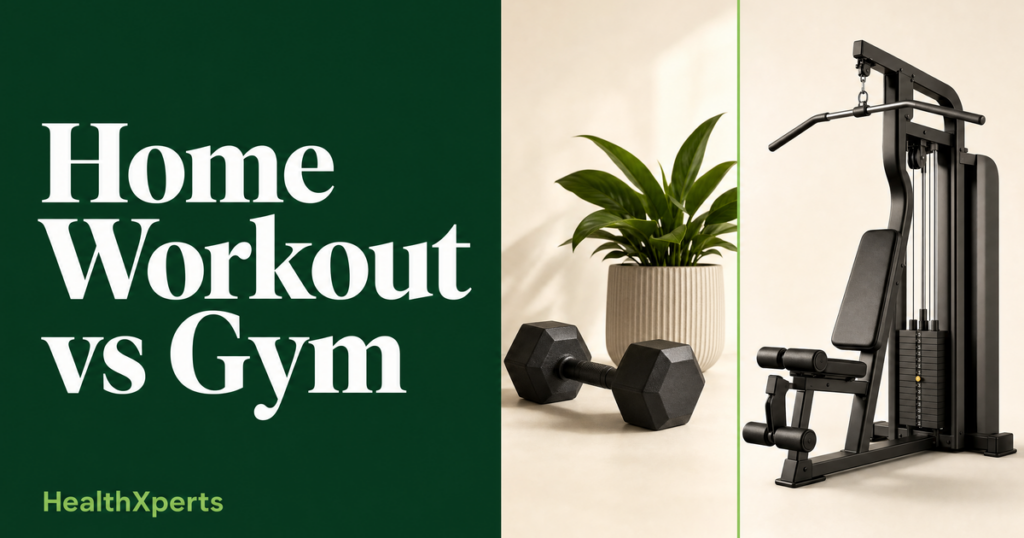
It’s one of the most common questions for anyone starting their fitness journey: should I work out at home or join a gym?
Both have real advantages. Both have genuine drawbacks. And the honest answer is that the best option depends on your lifestyle, your goals, and what you’re actually going to stick to.
This post gives you a straight comparison so you can make the right decision for where you are right now, not where you hope to be in a year.
The Case for Home Workouts
No Commute, No Excuses
The single biggest advantage of training at home is convenience. There’s no travel time, no parking, no waiting for equipment. You walk into your living room, pick up your dumbbells, and you’re already there.
This matters more than most people realise. Research consistently shows that one of the strongest predictors of exercise adherence is how easy it is to start. Every barrier you remove, even a 15-minute drive. Significantly increases the chance you’ll actually do it.
It’s Significantly Cheaper
Home training is significantly cheaper for most people, but the exact difference depends on your gym, your travel distance, and what equipment you buy. Our home gym cost calculator runs the real numbers using dated UK prices so you can compare your own situation.
No Intimidation Factor
Gym intimidation is real and widely underreported as a barrier to starting. Walking into a weights room as a complete beginner. Surrounded by experienced lifters, unfamiliar equipment, and unwritten social rules. Is genuinely off-putting for many people.
At home, you can learn at your own pace, make mistakes without an audience, and take as long as you need on each exercise without feeling self-conscious. For beginners, this is a significant psychological advantage.
Flexible Scheduling
Home workouts fit around your life rather than requiring your life to fit around them. You can train at 6am, during a lunch break, or at 10pm. You’re not constrained by gym opening hours, class schedules, or peak-time crowds.
The Case for the Gym
Access to More Equipment
A gym gives you access to barbells, cable machines, a full range of dumbbell weights, resistance machines, and cardio equipment. As your fitness develops and your goals become more specific, having that variety becomes increasingly useful.
For beginners, this advantage is smaller than it sounds. You don’t need a barbell or 20 different dumbbell weights to get excellent results in your first 3–6 months. But it becomes more relevant as you advance.
A Dedicated Environment
For some people, having a place they go specifically to train is motivating. The gym becomes associated with effort and focus in a way that the living room, where you also watch TV, eat meals, and relax. Sometimes can’t replicate.
If you struggle to mentally “switch on” for a home workout because of distractions or the association between home and rest, a gym environment can genuinely help.
Social Accountability
Training alongside other people, even strangers. Creates a subtle social pressure to keep going. Group fitness classes add a structured community element. Having a training partner makes skipping far less likely.
If you’re someone who thrives on social accountability, the gym has a clear edge here. Home workouts require more internal motivation to stay consistent.
Access to Professional Guidance
Gyms often have personal trainers available, and even without paying for PT sessions, having experienced staff nearby to answer form questions is useful for beginners. At home, you’re relying on online resources and your own judgement.
🎯 Starting at home? Get the free plan.
The 28-Day Home Workout Blueprint gives you a structured, week-by-week plan using just a pair of dumbbells. Everything you need to get started today.
Get the Free Blueprint →Home Workout vs Gym: Side-by-Side
| Home Workout | Gym | |
|---|---|---|
| Cost | Low (one-off equipment cost) | £25–£60/month ongoing |
| Convenience | Very high. No travel needed | Requires travel and scheduling |
| Equipment variety | Limited | Extensive |
| Intimidation | None | Can be high for beginners |
| Flexibility | Train any time | Limited to opening hours |
| Social element | None (unless you choose) | Built-in community |
| Expert guidance | Online resources only | Staff and trainers available |
| Best for | Beginners, busy schedules, budget-conscious | Advanced goals, social motivation, variety |
Can You Get the Same Results at Home?
For the first 6–12 months of training, yes. Absolutely. The fundamentals of building muscle and losing fat are the same whether you’re in a gym or your living room: progressive overload, adequate protein, consistency, and sufficient sleep.
A well-structured dumbbell programme will build real muscle, improve strength, and change your body composition. The results won’t be inferior to a gym programme. They’ll just look slightly different in terms of which movements you use.
Where the gym starts to offer a meaningful advantage is for people with very specific goals. Competitive powerlifting, bodybuilding at an advanced level, or training that requires heavy barbell work. For general fitness, fat loss, and building a strong, functional body, home training is fully capable of delivering excellent results.
Which Should You Choose?
Here’s a simple decision guide:
Choose home workouts if:
- You’re completely new to exercise
- Your schedule is unpredictable or very busy
- You’re on a tight budget
- The idea of a gym feels intimidating right now
- You want to build a consistent habit before adding complexity
Choose the gym if:
- You thrive on social accountability and community
- You have specific goals that require heavy barbell work
- You find it genuinely hard to focus on training at home
- You want access to a wider variety of equipment
- You already have a consistent training habit and want to progress further
Why Consistency Matters More Than Where You Train
There is a concept in exercise science called training hysteresis. When you train consistently, your body makes permanent structural changes. The nuclei added to muscle cells during training persist for years, even after you stop. Your tendons and connective tissue adapt slowly but hold those adaptations longer than muscle does. Your nervous system gets better at recruiting muscle efficiently, and that efficiency sticks.
What this means in practice: three years of twice-weekly home dumbbell training produces more lasting biological change than six months of four-times-weekly gym training followed by two and a half years of nothing. The gym programme was more intense. The home programme was more consistent. In the long run, consistency always wins.
That is the real argument for whichever option you will actually stick with. If you will go to the gym three times a week for years, go to the gym. If removing the commute means you will actually train at home twice a week indefinitely, that consistency is worth more than any equipment advantage.
Frequently Asked Questions
Can I build muscle without a gym?
Yes. Muscle growth requires progressive tension on the muscle, not a specific location or piece of equipment. A structured dumbbell programme with progressive overload will build real, visible muscle. Read our guide to progressive overload for beginners for exactly how to do this at home.
Should I start at home and then move to a gym?
That’s a perfectly sensible approach. Building a consistent routine at home first means that when you do go to a gym, you already have good habits, basic movement patterns, and a foundation of fitness. You’ll get significantly more from the gym experience having already built that base.
What equipment do I need for an effective home workout?
A single pair of dumbbells is enough to get started. As you progress, adding a second heavier pair or an adjustable dumbbell set expands your options significantly. See our guide to the best dumbbells for home workouts under £50.
Is the gym worth it for beginners?
It can be, particularly if you respond well to structured environments or want access to a personal trainer. But for many beginners, the gym adds complexity and cost before they’ve built the habit. Starting at home removes those barriers and makes consistency more achievable.
Final Thoughts
The best workout is the one you’ll actually do. For most beginners, that means starting at home, where the barriers are lower, the cost is minimal, and the convenience is unmatched.
Build the habit first. Get consistent. See results. Then decide whether the gym adds anything meaningful to what you’ve already built.
Ready to get started at home? Download the free 28-Day Home Workout Blueprint. A complete beginner plan using just a pair of dumbbells.
If you’ve decided home training is your path, our guide on how to start working out at home with just dumbbells covers everything you need from equipment to your first session.
This post contains affiliate links. If you purchase through these links I may earn a small commission at no extra cost to you.
🏆 Recommended Dumbbells. PAPABABE HEX Set
⭐⭐⭐⭐⭐ 4.7 stars | 3,390+ reviews | Amazon’s Choice | From £17.09 a pair
Check Price on Amazon →