The shoulder is the most mobile joint in the body. It can move in more directions, through a wider range, than any other joint you own. That mobility is also why it’s the joint most likely to fail you.
Mobility and stability exist in tension: the more freely a joint can move, the more muscular and structural support it requires to move safely. The shoulder’s extraordinary range of motion depends on an intricate system of four small rotator cuff muscles, the long head of the biceps, multiple bursae, the acromioclavicular joint, and the glenohumeral capsule all working in precise coordination. When any part of that system is weak, tight, or poorly coordinated, the shoulder becomes the most vulnerable structure in the upper body.
For people over 40, shoulder problems are almost epidemic. Rotator cuff tears, partial or complete, are increasingly common after 60. Shoulder impingement, labral tears, joint wear, and tendon problems are not random bad luck. They’re largely the predictable consequence of spending decades with the shoulder in the rounded, internally rotated position that desk work and screen time creates, combined with the almost complete absence of overhead loading in most people’s daily lives.
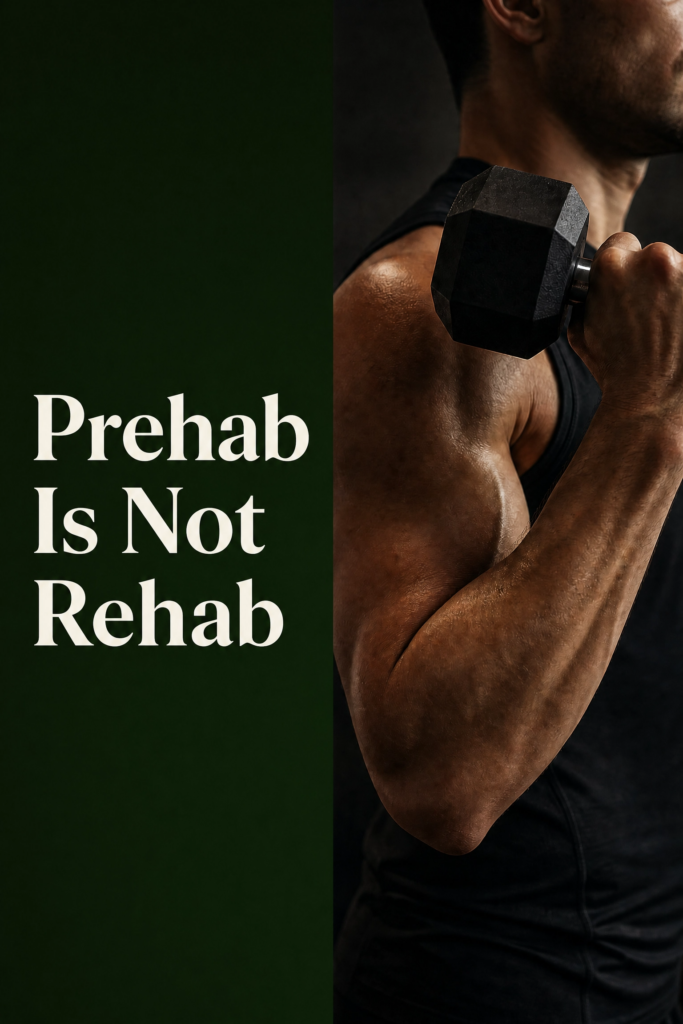
Prehab is the practice of training the shoulder’s stability and coordination systems before they fail, not in response to pain, but in anticipation of the demands that will eventually expose their weakness. It’s not the same as rehabilitation. Rehab starts from injury. Prehab starts from health, and keeps you there.
Why the Modern Shoulder Is Already Compromised
The shoulder’s resting position tells you a lot about the loads it’s been exposed to. In a person who spends 8 hours a day at a desk, the resting shoulder position is typically internally rotated, anteriorly tilted, and elevated. The pectorals are chronically shortened. The external rotators are chronically lengthened and weak. The lower trapezius, the muscle responsible for pulling the shoulder blade down and stabilising it against the ribcage, is underactive to the point of near-dormancy in most desk workers.
This resting position isn’t just a postural issue. It changes the mechanics of every overhead movement. When the shoulder blade doesn’t rotate upward correctly during arm elevation, a movement called scapular upward rotation, the subacromial space narrows. The rotator cuff tendons that pass through this space get repeatedly compressed against the acromion with every overhead reach. Over years, this repeated compression produces the gradual wear that eventually becomes a rotator cuff tear.
The person who experiences a rotator cuff tear “reaching for something on a high shelf” didn’t injure their shoulder in that moment. They injured it over a decade of compromised shoulder mechanics, and the shelf simply provided the final load that the already-damaged tissue couldn’t absorb. Understanding this changes how you approach shoulder training. You’re not just building strength. You’re restoring the mechanics that chronic sitting has degraded.
The Four Systems the Shoulder Needs
Standard upper body training, bench press, overhead press, rows, develops the prime movers but largely ignores the four systems that actually determine whether the shoulder stays healthy under load.
The Shoulder Armour Framework: four systems that determine shoulder resilience, and that standard training consistently underdevelops:
- External rotation strength: The infraspinatus and teres minor, the two external rotators of the rotator cuff, are almost universally weak in people who press regularly but don’t train rotational pulling. They’re the primary decelerators of the throwing and pressing motion, and their weakness is the most common structural contributor to rotator cuff injury.
- Scapular stability: The lower trapezius, serratus anterior, and middle trapezius control the position and movement of the shoulder blade. Without active scapular stability, the glenohumeral joint loses its stable base and compensatory patterns develop that create impingement mechanics.
- Posterior capsule flexibility: Tightness in the posterior glenohumeral capsule, extremely common in people who press without balancing their pulling, shifts the humeral head forward in the socket, reducing subacromial space and compressing the rotator cuff tendons with every overhead movement.
- Overhead control: The capacity to stabilise the shoulder in full overhead reach, not just reach there, but hold and control load there, requires coordination of all the preceding systems simultaneously. Most people have never trained this capacity deliberately.
The Armour Building Complex trains all four systems in a single 12-minute sequence, using a single light dumbbell. The load is deliberately light, the limiting factor in every movement is stability and control, not strength. Reaching for heavy weights in shoulder prehab misses the point entirely. You’re training the stabilisers, not the prime movers.
The Armour Building Complex
Equipment: One light dumbbell, 2 to 4kg. If this feels too light when you first pick it up, it’s probably correct. By the end of the sequence, it will feel like a different weight entirely.
Frequency: 3 times per week. Can be performed before strength training as a warm-up, or as a standalone session on recovery days.
Total time: 12 minutes.
Perform each movement on one side before switching. Always begin with the weaker or previously injured shoulder.
Movement 1: Side-Lying External Rotation (90 seconds each side)
Target: infraspinatus, teres minor, the external rotators.
Lie on your side, elbow bent to 90 degrees, upper arm resting against your body. Hold the dumbbell in the upper hand. Keeping the elbow pinned to your side, rotate the forearm upward toward the ceiling as far as your range allows. Lower slowly. The movement is small, only the forearm moves. The elbow stays pinned throughout.
This is the exercise that most people feel burning with a weight that would feel trivial in any other context. If 2kg feels easy here, the external rotators are adequately developed. Most people find that even 2kg produces significant fatigue within 60 seconds, which tells you exactly how underworked these muscles are relative to the pressing muscles they’re meant to balance.
Sets and tempo: continuous movement for 90 seconds, no rep counting. 2 seconds up, 3 seconds down. The slow lowering is where the external rotators build their eccentric strength, the capacity to decelerate and control the returning motion that prevents labral and capsular damage during pressing movements.
Movement 2: Prone Y-T-W Raises (60 seconds each letter, each side)
Target: lower trapezius, middle trapezius, serratus anterior.
Lie face down on the floor, arms at your sides. With the dumbbell in one hand, raise the arm to form a Y shape (above head level, thumb pointing up), hold 2 seconds, lower. Then raise to form a T (out to the side, thumb pointing up), hold 2 seconds, lower. Then bend the elbow and raise to form a W (elbows up and out, creating a W shape), hold 2 seconds, lower.
Each position targets a different portion of the trapezius and the muscles responsible for scapular positioning. The Y targets lower trapezius. The T targets middle trapezius and rhomboids. The W targets the rotator cuff and the muscles that retract and depress the scapula simultaneously.
Why prone: the face-down position removes the contribution of momentum and requires the posterior shoulder muscles to work against gravity in the exact plane where they’re most needed. People who can row impressively often struggle to hold the Y position for more than a few seconds, because the prone position isolates the lower trapezius in a way that rows cannot.
Movement 3: Sleeper Stretch to External Rotation (60 seconds each side)
Target: posterior glenohumeral capsule, internal rotation range.
Lie on your side with the lower arm extended forward at shoulder height, elbow bent to 90 degrees, forearm pointing toward the ceiling. Use your upper hand to gently press the lower forearm toward the floor, creating a posterior capsule stretch. Hold 20 seconds at the end of the comfortable range.
Then, without moving the upper arm from its position, pick up the dumbbell in the lower hand and perform 10 slow external rotations (forearm moving toward ceiling). The combination of posterior capsule stretch followed immediately by external rotation work at the stretched position is significantly more effective than either intervention performed separately.
This movement is adapted from physiotherapy practice and is particularly effective for people who already have mild pinching or catching in the shoulder, a pinching sensation at the front of the shoulder during overhead reach. If symptoms worsen during this movement, reduce the stretch intensity and consult a physiotherapist.
Movement 4: Wall Slide with Overhead Hold (60 seconds each side)
Target: serratus anterior, overhead stability, scapular upward rotation.
Stand facing a wall, one arm bent at 90 degrees with the forearm flat against the wall. Hold the dumbbell in the wall-side hand. Slowly slide the forearm up the wall until the arm is fully extended overhead, maintaining contact between the forearm and the wall throughout. Hold the overhead position for 5 seconds. Slide back down.
The wall provides feedback, if the shoulder blade is winging (lifting away from the ribcage), contact with the wall is lost. The movement teaches the serratus anterior to keep the scapula flat against the ribcage during overhead reach, which is the single most important factor in maintaining subacromial space and preventing impingement.
Sets and reps: 8 slow repetitions each side. Focus entirely on maintaining scapular contact rather than reaching as high as possible. A smaller range with the scapula well-controlled is more valuable than full overhead reach with a winging blade.
🎯 Want the complete training framework?
The free 28-Day Home Transformation Blueprint integrates the Armour Building Complex into a complete weekly structure alongside strength, Zone 2, and mobility work.
Get the Free Blueprint →How to Progress the Complex Over 8 Weeks
The Armour Building Complex is not a strength protocol, progression is measured differently here. You’re not trying to lift more weight. You’re trying to perform each movement with greater control, cleaner mechanics, and less compensatory movement.
Weeks 1 to 4: focus entirely on movement quality. Film yourself from the front and side performing each movement once per week, the compensations that are invisible when you’re doing the exercise are often immediately obvious on video. The most common compensations to look for: elbow drifting away from the body during external rotation (reduces the isolation of the target muscles), shoulder blade winging during wall slides (indicates serratus weakness), and excessive trunk rotation during Y-T-W raises (indicates the target muscles are too weak to maintain the position without help).
Weeks 5 to 8: when compensations are resolved, increase load by 0.5 to 1kg in the external rotation and Y-T-W movements only. The wall slide and sleeper stretch remain at the same load, in these movements, more load doesn’t improve the adaptation target, it just increases injury risk.
After 8 weeks of the Armour Building Complex, the shoulder feels different during overhead pressing and carrying movements. The stability is palpable, there’s a quality of controlled support that wasn’t there before. This is the serratus, lower trap, and external rotators doing the job they were designed for, having finally been trained to do it. The single-arm overhead carry from the Osteoporosis Shield protocol becomes both safer and more effective when the Armour Building Complex has been applied first, the bone-loading stimulus of the carry is only fully accessible when the shoulder mechanics supporting it are sound. And for anyone working through the asymmetrical armour protocol, the shoulder prehab work here directly addresses the rotational stability demands that uneven loading exposes.
A Note on Existing Shoulder Pain
If you have existing shoulder pain, particularly pain with overhead movements, pain at the front of the shoulder during pressing, or pain that wakes you at night, this protocol may be appropriate, but it requires more care in application.
Pain that increases during any movement in this protocol is a signal to stop that movement and reduce either the load or the range. Mild discomfort, the ache of muscles that haven’t been worked in their proper function before, is expected and appropriate. Sharp pain, pain that radiates down the arm, or pain that persists significantly after the session ends warrants a physiotherapy assessment before continuing.
The Armour Building Complex was designed as a prehab protocol, for shoulders that are functional but undertrained. If your shoulder is already injured, a physiotherapist is the appropriate starting point, and this protocol may form part of the recovery plan they design rather than a standalone intervention.
Frequently Asked Questions
How do I know if my shoulder mechanics are already compromised?
Three simple tests. First: stand with your back against a wall, heels and hips touching it. Can you raise both arms overhead without your lower back arching or your arms losing contact with the wall? If not, shoulder mobility or thoracic extension is restricted. Second: with your arm at your side, can you rotate your forearm to point behind you (external rotation) past 60 degrees? Reduced external rotation range indicates posterior capsule tightness. Third: can you reach the opposite shoulder blade from behind your back with both hands? Significant asymmetry in this measure indicates a mobility and stability difference worth addressing.
Should I stop pressing while doing this protocol?
No. The protocol is designed to complement pressing, not replace it. The ideal sequencing is to perform the Armour Building Complex before pressing sessions, it prepares the shoulder mechanics for the demands of pressing and significantly reduces the injury risk of the heavier loading that follows. Stopping pressing while doing prehab would remove the very demand that makes the prehab necessary.
Can I do this protocol daily?
The loads are light enough that daily use is generally safe, but the connective tissue adaptations the protocol is designed to produce require recovery time to consolidate. Three times per week is the recommended frequency for structural adaptation. On non-protocol days, the sleeper stretch alone can be performed daily as a maintenance intervention for posterior capsule mobility.
How long before I notice a difference?
Most people notice improved stability during overhead movements within 3 to 4 weeks, the neural adaptations come first. Structural changes to the rotator cuff muscles, lower trapezius, and serratus anterior take 8 to 12 weeks to consolidate. The subjective feeling of a more stable, more capable shoulder during daily activities, reaching overhead, carrying bags, sleeping on the shoulder, typically becomes noticeable between weeks 4 and 8.
Final Thoughts
Rehabilitation is expensive, slow, and painful. It often involves months of restricted activity, physiotherapy costs, and the frustrating process of rebuilding capacity that was taken for granted before the injury.
Twelve minutes of prehab, three times a week, prevents most of that. Not guaranteed, injuries happen for reasons beyond poor mechanics, but the most common shoulder injuries in middle-aged adults are consistently linked to the predictable mechanical compromises that years of desk work create, and structured prehab genuinely reduces their likelihood.
The shoulder that fails you at 62 reaching for something overhead is the one you didn’t train in your 50s. The 12 minutes starts today.
This post contains affiliate links. If you purchase through these links I may earn a small commission at no extra cost to you.
🏋️ Recommended Dumbbells: PAPABABE HEX Set
⭐⭐⭐⭐⭐ 4.7 stars | 3,390+ reviews | Amazon’s Choice | From £17.09 a pair
Check Price on Amazon →HealthXperts provides general fitness information for healthy adults. This is not medical advice. If you have a health condition, injury, or are recovering from surgery, speak to your GP or physiotherapist before starting any exercise programme.