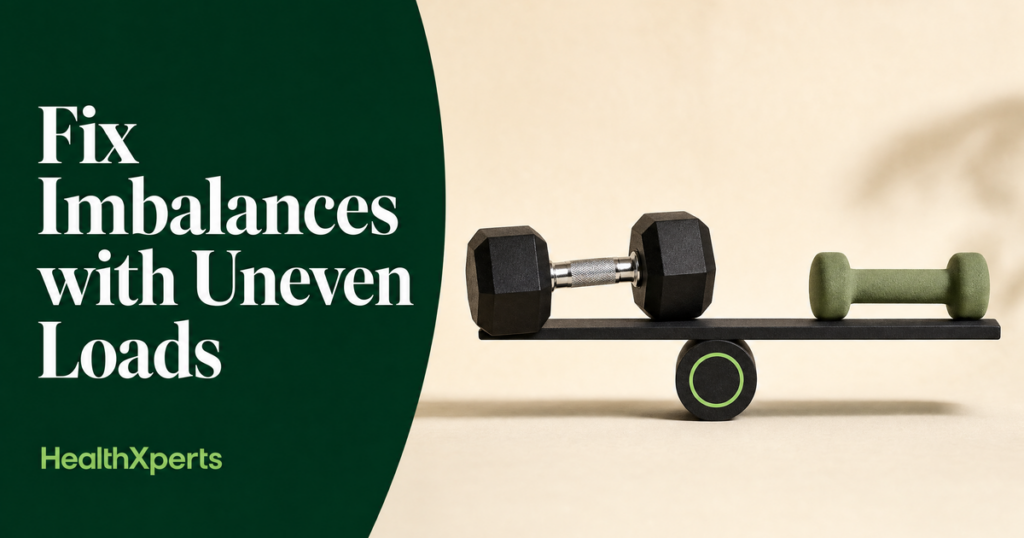
The body is not symmetrical. It never was. Your dominant hand is stronger. One hip is typically tighter. One shoulder sits slightly higher at rest. The left and right sides of the diaphragm fire at marginally different rates. These asymmetries are normal. They’re part of what makes human movement functional rather than robotic.
The problem is not asymmetry itself. The problem is asymmetry that exceeds the body’s capacity to compensate, and then encounters a demand that exposes it.
Most standard exercise programmes make this worse, not better. Bilateral training. Squatting, pressing, and pulling with the same load in both hands. Allows the stronger side to compensate for the weaker. The movement gets done. The reps get completed. But the imbalance that was present before the session is still present after it, and often deepened, because the stronger side has been reinforced while the weaker side has been allowed to underperform.
Intentional asymmetrical loading, using deliberately uneven loads to force each side of the body to work independently. Is the most direct available method for exposing, quantifying, and correcting the imbalances that accumulate silently until they produce an injury.
Why the Body Develops Asymmetry
Asymmetry develops through three primary pathways, and understanding which pathway is responsible for yours determines how to address it.
Dominance asymmetry. The dominant side of the body develops greater neural drive. The motor cortex fires more efficiently and recruits more motor units. Through years of preferential use. Right-handed people typically have stronger grip, elbow flexors, and shoulder complex on the right. Left-footed people push more powerfully through the left hip. These asymmetries are structural and functional, and they’re largely normal. The goal is not to eliminate dominance asymmetry but to ensure it doesn’t exceed approximately 10 to 15 percent side-to-side difference.
Postural asymmetry. Prolonged sitting, particularly with habitual lateral weight shifting (consistently leaning on one armrest, crossing the same leg, carrying a bag on the same shoulder), creates uneven loading of the spine, pelvis, and hip complex. Over months and years, this produces measurable differences in hip flexor tightness, gluteal activation, thoracic rotation, and shoulder height. None of which standard bilateral training corrects because the bilateral load pattern doesn’t expose them.
Injury asymmetry. Previous injuries, even those considered fully healed. Frequently leave residual movement pattern asymmetries. The nervous system develops protective compensation strategies around injured tissue, and those strategies persist long after the tissue has healed. A person who sprained their left ankle five years ago may still be loading the right leg preferentially when squatting, not from weakness or pain, but from a neural compensation that was never retrained.
A simple 4-test field assessment to identify your primary asymmetries before beginning the protocol:
- Single-leg balance test: Stand on one leg with eyes closed for 30 seconds. Repeat on the other. Compare steadiness. The wobblier side has weaker proprioceptive integration and hip stabiliser activation.
- Single-arm hold test: Hold a dumbbell in one hand at arm’s length for 60 seconds. Record when grip fatigue first appears. Repeat the other side. A difference of more than 15 seconds indicates significant grip asymmetry.
- Single-leg hip hinge test: Hinge forward on one leg, the other leg extending behind for counterbalance. Note how far you can hinge before losing spinal neutrality. Compare sides. The side that loses form earlier has weaker posterior chain stability.
- Overhead reach test: Reach both arms overhead and note whether one arm reaches further or whether the torso bends to one side. Uneven overhead reach indicates thoracic rotation restriction or shoulder mobility asymmetry.
Complete the Asymmetry Audit before starting the protocol. Note which side underperforms on each test. This is your weaker side for each movement pattern. The protocol addresses all four patterns, but knowing your specific asymmetry profile allows you to load the weaker side more deliberately during the exercises where it matters most.
The Bilateral Strength Deficit. Why Standard Training Doesn’t Fix This
When you perform a bilateral exercise. A standard dumbbell press or squat. The nervous system manages the movement as a single coordinated pattern. The stronger side contributes more force, the weaker side less, and the combined output achieves the desired movement. This is efficient. It’s also why bilateral training allows asymmetries to persist indefinitely.
The bilateral strength deficit is a well-documented phenomenon: most people can lift significantly more with two limbs than twice what they can lift with one. A person who can hold 20kg in each hand simultaneously often cannot hold 20kg in one hand alone. They can manage perhaps 16 or 17kg. The missing 3 to 4kg represents the compensation that the bilateral pattern was providing.
This deficit is not a problem in itself. It’s a normal feature of motor system organisation. The problem arises when the deficit is dramatically asymmetrical: when the dominant side can hold 17kg unilaterally but the non-dominant side can only manage 12kg. That 5kg gap is not normal variation. It’s a structural vulnerability that will express itself as injury at some point.
The solution is not to abandon bilateral training. Bilateral exercises have their place in any programme. The solution is to supplement them with intentional unilateral and asymmetrical loading that forces each side to perform independently and exposes the compensation that bilateral patterns conceal.
The Asymmetrical Armour Protocol
Four movements, each targeting a different asymmetry pattern. Perform this protocol 2 times per week as a supplement to your existing training. Total session time: approximately 20 minutes.
The key principle: Always begin each movement with the weaker side. When the weaker side sets the rep count, the stronger side matches it, rather than letting the stronger side set a target the weaker side then fails to reach. This is the most important loading principle in asymmetrical training.
Movement 1. Suitcase Deadlift
Targets: lateral core, hip stability, spinal asymmetry
Hold a single dumbbell in one hand at your side. As if picking up a heavy suitcase. Hinge at the hips and lower the dumbbell toward the floor, maintaining a completely neutral spine. The key challenge: resist the lateral pull of the unilateral load. The torso will want to bend toward the weighted side. The job of the opposite-side lateral core (quadratus lumborum, obliques, and lateral glute) is to prevent that bending.
This is where postural asymmetry is most directly exposed. The side with weaker lateral core stability will allow measurably more lateral trunk flexion during the lift. Watch yourself in a mirror if possible, or better, film yourself from the front. The side-to-side difference in trunk control is often striking and immediately visible.
Protocol: 3 sets of 8 reps each side. Begin with the weaker side. Use a load approximately 20 percent heavier than you’d use for a single-arm Romanian deadlift. The lateral core demand, not the hip hinge, is the limiting factor here. Rest 60 seconds between sides.
Movement 2. Single-Arm Overhead Press With Offset Stance
Targets: shoulder asymmetry, thoracic rotation, hip-shoulder dissociation
Stand in a split stance. The foot opposite to the pressing arm forward, the same-side foot back. Press a single dumbbell overhead to full extension. The offset stance creates a rotational challenge: the body must resist the tendency to rotate toward the pressing side, which directly loads the anti-rotation muscles of the core and exposes thoracic mobility asymmetries.
People with thoracic rotation restrictions. Extremely common in desk workers. Often find that one side allows a clean vertical press while the other produces a visible trunk lean or forward shoulder drift. This is the thoracic restriction revealing itself under load. The movement doesn’t create the problem. It makes an invisible problem visible.
Protocol: 3 sets of 8 reps each side. Begin with the weaker shoulder. Use a load lighter than your standard bilateral press. Approximately 70 percent of your usual pressing weight. To allow focus on the rotational stability demand rather than the pressing load.
Movement 3. Contralateral Dumbbell Lunge
Targets: hip asymmetry, single-leg stability, injury compensation patterns
Hold a single dumbbell in the hand opposite to the stepping leg. Right dumbbell, left leg stepping forward. This contralateral loading creates a rotational demand through the thoracolumbar fascia that bilateral lunges and even standard unilateral lunges don’t produce. The body must resist the torque created by the offset load while also managing the single-leg stability of the lunge itself.
This movement is particularly effective for exposing injury-related compensation patterns. People with previous ankle, knee, or hip injuries consistently show measurably different movement quality between sides. The compensating side produces shallower range, faster movement, and subtle trunk shifts that protect the previously injured tissue. These patterns are often invisible in bilateral lunges.
Protocol: 3 sets of 8 reps each leg. Begin with the weaker or previously injured leg. Use the same load on both sides. The goal is to expose the asymmetry in movement quality, not load capacity. Slow the descent to 3 seconds to maximise the stability challenge.
Movement 4. Uneven Floor Press
Targets: shoulder asymmetry, thoracic rotation, pressing dominance
Lie on your back with one dumbbell in each hand, but deliberately uneven loads. The weaker side holds your standard working weight. The stronger side holds 20 to 30 percent less. Press both dumbbells simultaneously. The lighter load on the stronger side does not produce a bilateral press. It creates an active resistance challenge for the stronger side (which must control a lighter load without allowing it to dominate the movement) while the weaker side works at full capacity.
This is the most counterintuitive movement in the protocol. The stronger side is not working harder. It’s working differently. Learning to control a lighter load under the influence of a heavier load on the other side requires sophisticated motor system coordination that standard training never develops.
Protocol: 3 sets of 10 reps. Load the weaker side at working weight, the stronger side at 70 percent of that. Focus on keeping both dumbbells moving at the same speed and reaching the same height at the top of each rep. The asymmetrical load will continuously challenge this.
🎯 Want the complete 28-day structure?
The free 28-Day Home Transformation Blueprint integrates asymmetrical training, strength work, and mobility into a single weekly plan, so every vulnerability gets addressed.
Get the Free Blueprint →How to Progress the Protocol Over 8 Weeks
The goal of the protocol is convergence. Closing the gap between the stronger and weaker sides. Progress is measured not by increasing total load but by reducing the performance differential between sides.
Reassess the Asymmetry Audit at week 4 and week 8. For most people, the audit tests show measurable convergence within 4 weeks. The single-leg balance duration equalises, the single-arm hold times come closer, the hip hinge depth matches more closely between sides.
- Weeks 1–4: Perform the protocol as described. Focus entirely on movement quality and side-to-side consistency rather than load.
- Weeks 5–8: Increase the load on the weaker side by 1–2kg when that side can match the movement quality of the stronger side for all 3 sets. Do not increase the stronger side’s load simultaneously. Allow the weaker side to close the gap before raising the overall standard.
- After week 8: If the asymmetry has reduced to less than 10 percent difference between sides, transition to a standard progressive loading approach for both sides. If the asymmetry remains significant, continue the differential loading for a further 4 weeks before reassessing.
The connection between asymmetry correction and injury prevention is direct. The Osteoporosis Shield protocol and the density training protocol both benefit from reduced asymmetry. Movements performed with better bilateral balance produce more even bone loading and more consistent metabolic stimulus across both sides of the body.
Frequently Asked Questions
How much asymmetry is normal?
Up to 10 to 15 percent side-to-side difference in strength and stability measures is within the normal range for most adults. Differences exceeding 15 percent, particularly in hip stability, shoulder strength, or grip. Are associated with significantly increased injury risk and warrant targeted correction. The Asymmetry Audit gives you a practical way to identify whether your asymmetries fall within or outside this range.
Should I stop bilateral training while doing this protocol?
No. The asymmetrical protocol supplements rather than replaces bilateral training. Bilateral exercises build overall strength and provide the foundation that unilateral work refines. A sensible structure is to perform bilateral compound movements first in a session and add the asymmetrical protocol as a secondary block, or on separate days if training frequency allows.
My non-dominant side is significantly weaker. How long will it take to close the gap?
Gaps of 15 to 25 percent typically close meaningfully within 6 to 12 weeks of consistent unilateral training. The nervous system adapts quickly when the weaker side is required to perform independently. Neural drive improvements are faster than structural muscle growth. Expect the first 4 weeks to produce primarily neural adaptation (better coordination and recruitment) and weeks 5 to 12 to produce more structural changes.
Can asymmetrical training cause injury?
When performed with appropriate loads and attention to movement quality, no. The risk comes from using loads that are too heavy for the stabilisation demands, particularly in the suitcase deadlift and offset press, where the lateral core and rotational stability requirements are significant. Start lighter than you think necessary and prioritise spine neutrality over load. If you feel acute pain, not muscular effort, but sharp or joint pain. Reduce the load or modify the movement.
Final Thoughts
Injuries almost always feel sudden. They’re not. They’re the final expression of an imbalance that has been building for months or years. An asymmetry that standard training was reinforcing rather than correcting, until one movement, one load, or one moment of fatigue exceeded the body’s capacity to compensate.
The asymmetrical armour protocol doesn’t prevent all injuries. But it systematically closes the gaps that most injuries exploit. By forcing each side of the body to perform honestly, without the cover that bilateral training provides.
The body you build training asymmetrically is not more impressive than one built on standard bilateral work. It’s more resilient. And resilience. The capacity to absorb unexpected demands without breaking. Is worth more than strength at any age.
For another way to build serious muscle with minimal equipment, read about BFR-style training with a dumbbell and resistance band at home.
This post contains affiliate links. If you purchase through these links I may earn a small commission at no extra cost to you.
🏆 Recommended Dumbbells. PAPABABE HEX Set
⭐⭐⭐⭐⭐ 4.7 stars | 3,390+ reviews | Amazon’s Choice | From £17.09 a pair
Check Price on Amazon →