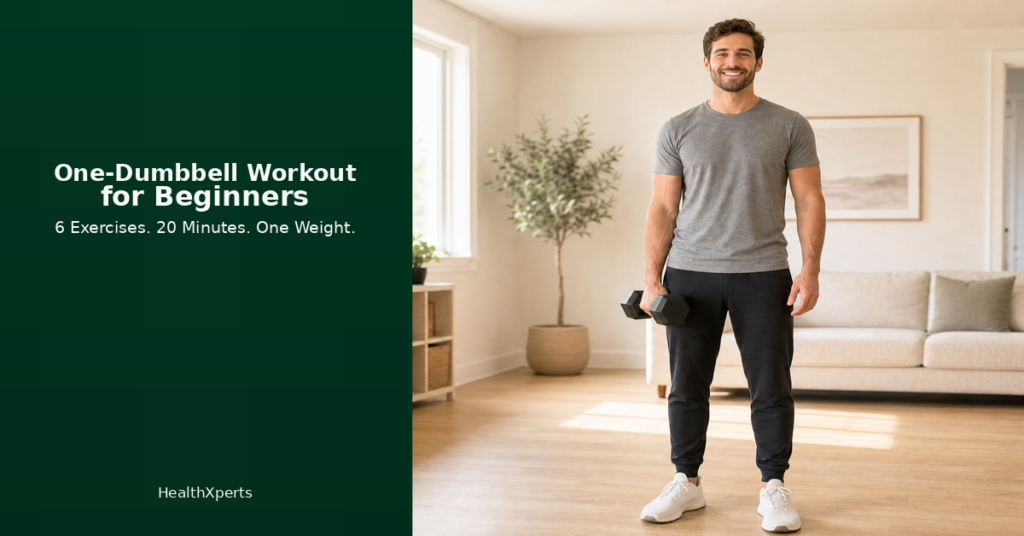
Quick Summary: You don’t need a full home gym to train with weights. A single dumbbell allows you to add resistance to exercises for your back, shoulders, legs, and other major muscle groups. This beginner workout uses one dumbbell for six exercises and takes about 20 minutes.
If you’ve been training with bodyweight and you’re ready for something more, a single dumbbell is the simplest upgrade you can make.
One dumbbell lets you load exercises that are hard to progress with bodyweight alone. Rows for your back. Presses for your shoulders. Deadlifts for your hamstrings. Goblet squats that challenge your legs more than an air squat ever will. You don’t need a matching pair to start, and you don’t need a rack or a bench.
This workout is built around what one dumbbell actually does well.
Who This Workout Is For
This routine is for you if:
- You’ve outgrown bodyweight-only training and want to add resistance.
- You own one dumbbell (or one pair) and aren’t sure what to do with it.
- You want a structured session, not a random list of exercises.
- You’re not ready to invest in a full equipment setup yet.
If you have a current injury, persistent pain, or a diagnosed health condition, check with an appropriate healthcare professional before starting. Stop if you feel sharp pain, chest pain, or unusual dizziness during any exercise.
If you don’t own a dumbbell yet, our weight selection guide helps you choose a starting weight. And if you’d rather start without any equipment, the no-equipment beginner workout is a better starting point.
Before You Begin
You need a clear floor area and one dumbbell. If you have a pair, use one at a time for single-arm exercises and hold both for bilateral movements like the goblet squat.
Warm up for two or three minutes with light movement. Arm circles, bodyweight squats, and a few lunges will do. The aim is to get your joints moving, not to tire yourself out.
If you’re unsure about your dumbbell weight, start lighter than you think you need to. You can always go heavier next session. The weight selection guide explains how to test this for each exercise.
The Six Exercises
These movements cover pushing, pulling, legs, and core. That’s the advantage of adding a dumbbell: you can now train pulling movements (like a row) that are difficult with bodyweight alone.
1. Goblet Squat
Works: quads, glutes, core
Hold the dumbbell vertically at chest height with both hands cupping the top end. Feet shoulder-width apart. Squat down, keeping your chest up and elbows inside your knees. Stand back up.
The goblet position forces you to stay upright, which makes the squat easier to control than holding a weight at your sides. If bodyweight squats feel manageable, a goblet squat is one option for adding resistance.
2. Single-Arm Row
Works: upper back, lats, biceps
Place your free hand on a sturdy chair or the edge of a sofa for support. Hinge forward at the hips so your torso is roughly 45 degrees to the floor. Let the dumbbell hang straight down, then pull it toward your hip. Lower it slowly. Do all reps on one side, then switch.
The row gives you a practical pulling movement that bodyweight-only training does not easily provide.
3. Dumbbell Romanian Deadlift
Works: hamstrings, glutes, lower back
Hold the dumbbell in both hands in front of your thighs. Stand with feet hip-width apart. Push your hips backward and lower the dumbbell along your legs, keeping a slight bend in your knees. Stop when you feel a stretch in your hamstrings or when your back starts to round. Squeeze your glutes to stand back up.
Move slowly and keep the weight close to your body. This isn’t about touching the floor. It’s about loading your hamstrings through a range you can control.
4. Dumbbell Floor Press
Works: chest, front shoulders, triceps
Lie on your back with knees bent. Hold the dumbbell in one hand with your upper arm resting on the floor and your elbow at roughly 45 degrees from your body. Press the weight straight up until your arm is extended. Lower it back down until your upper arm touches the floor. Do all reps on one side, then switch.
The floor limits how far your elbow can drop, giving you a clear stopping point while you practise the movement. It’s also a natural progression from push-ups once you want more resistance.
5. Supported Dumbbell Reverse Lunge
Works: quads, glutes, hamstrings, balance
Hold the dumbbell in one hand at your side (a suitcase hold). Step one foot backward and lower your back knee toward the floor. Push through your front heel to return to standing. Alternate legs each rep.
Hold a wall or sturdy chair lightly if balance is difficult. You can also replace the reverse lunge with a supported split squat. If holding the weight on one side feels too unstable, hold the dumbbell in both hands at your chest like a goblet squat.
6. Suitcase March
Works: core, balance, trunk stability
Stand tall while holding the dumbbell in one hand. Keep your shoulders level and your torso upright. Slowly march in place without leaning towards the weight. Complete the repetitions or time on one side, then switch.
If marching feels unstable, keep both feet on the floor and perform a suitcase hold instead.
The Workout
Do these six exercises as a circuit. One set of each, then rest, then repeat.
| Exercise | Reps | Notes |
|---|---|---|
| Goblet Squat | 10-12 | Chest up, elbows inside knees |
| Single-Arm Row | 8-10 each side | Pull toward hip, slow lower |
| Romanian Deadlift | 10-12 | Hips back, weight close to legs |
| Floor Press | 8-10 each side | Upper arm touches floor each rep |
| Reverse Lunge | 8 each leg | Alternate legs, control the step back |
| Suitcase March | 20-30 seconds each side | Stay tall, do not lean |
Rest: 30-60 seconds between exercises. 90 seconds between rounds.
Rounds: Start with 2 rounds. Build to 3 when you can finish 2 rounds with steady form.
Total time: About 20 minutes for 3 rounds.
How to Progress
As the workout becomes manageable, choose one of these changes at a time:
Add reps. Move from 10 goblet squats to 12, then 15. Move from 8 rows to 10, then 12.
Slow the lowering phase. Take 3-4 seconds to lower the weight on each rep. This increases time under tension without needing a heavier dumbbell.
Add a pause. Hold the bottom of a goblet squat for 2 seconds. Pause at the top of each row for a count. Pauses remove momentum and make every rep harder.
Add a round. Go from 2 rounds to 3 when the third round feels manageable.
Go heavier. When you’ve maxed out reps, tempo, and rounds, a heavier dumbbell is the next step. You don’t need a full set. One step up in weight can keep you progressing for weeks.
If you’re ready for a full structured programme with daily sessions planned out, the 28-day dumbbell plan is the next step.
How Often Should You Do This?
Two or three times a week with at least one rest day between sessions. Recovery matters. You don’t need to train this routine every day, and giving yourself rest days can make it easier to stay consistent.
If you’re combining this with the no-equipment workout, you could alternate between the two. Dumbbell day on Monday, bodyweight on Wednesday, dumbbell again on Friday. That gives you variety without needing to buy more equipment.
One Dumbbell or a Pair?
Both work. A single dumbbell handles every exercise in this workout because most of them are single-arm movements anyway.
A pair becomes more useful when you want to do bilateral exercises like a standing overhead press or farmer’s walks. But you don’t need to buy a pair before you start. Use what you have. If you decide later that a second dumbbell would help, the starter kit guide covers what’s worth buying and what you can skip.
Frequently Asked Questions
What weight dumbbell should I use?
Choose a weight that allows you to complete the planned repetitions with controlled technique. The final few repetitions can feel demanding, but you should still be able to maintain good form. If your technique changes, you need to hold your breath, or you feel joint pain, stop the set and use a lighter weight or easier variation. Our weight selection guide walks through how to test this.
Can I do this workout every day?
You don’t need to. Two or three sessions a week with rest days in between is enough. Rest gives your body time to recover and adapt to the training.
What if the dumbbell is too heavy for some exercises and too light for others?
That’s normal. Your legs are stronger than your arms, so a weight that challenges your rows might feel light for goblet squats. Adjust by adding reps, slowing the tempo, or adding pauses on the exercises where the weight feels too easy.
Do I need a bench?
No. Every exercise in this workout uses the floor, a chair, or standing position. A bench becomes useful later if you want to expand your exercise options, but it’s not needed to start.
Is one dumbbell enough to build muscle?
For many beginners, yes. A single dumbbell can provide enough resistance to improve strength and practise muscle-building training. As you become stronger, you may need more load, different exercise variations, or additional equipment.
What to Do Next
Pick up the dumbbell and run through 2 rounds. It takes about 15 minutes. Record which exercises felt hardest and whether the weight was right.
Do it again in two days. After a few weeks, you’ll know whether you want to stick with this format or move to the 28-day dumbbell plan for a full structured programme.
You don’t need a full gym setup to start training with weights. One dumbbell and a clear floor is enough.
This article provides general fitness information for educational purposes. It isn’t medical advice, diagnosis, or personalised exercise programming. If you have health concerns, speak with an appropriate professional before starting.